
Mold Remediation in Pennsylvania and New Jersey

Mack's Mold Remediation Services

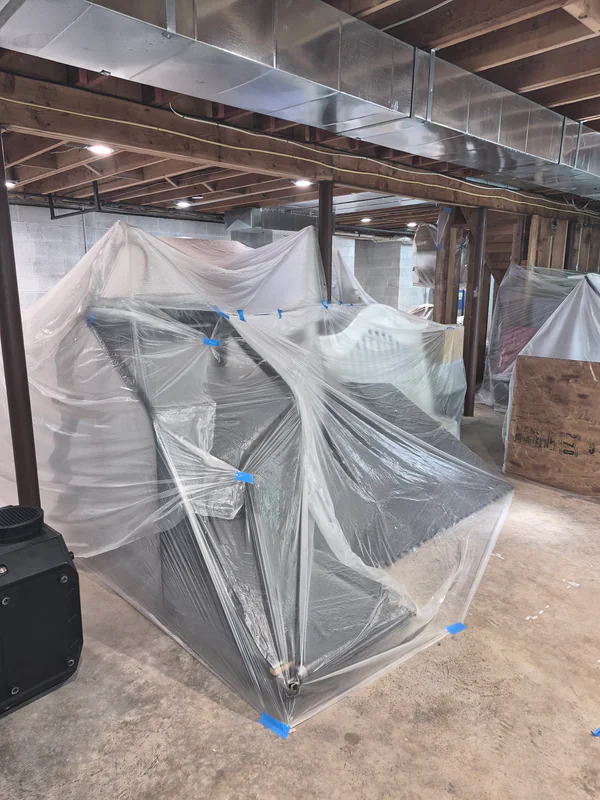
Plastic covered furniture in secure storage facility for moving and storage services in Bucks County, Pennsylvania

Find the water

Mack's works Bucks County, Philadelphia and the surrounding counties, and into New Jersey.

Mold only

Mold is the whole business here, not a sideline to water damage or carpet cleaning.

Seven days a week

Reachable 8am to 8pm, seven days, because a mold question rarely waits for a Monday.

5.0 from 137 reviews

Every one left by homeowners across Bucks County and Philadelphia on the Google listing.

Peeling ceiling with visible pipe damage in a Bucks County, Pennsylvania property.

Mold remediation in Bucks County and Philadelphia

Remediation is a water job before it is a cleaning job

Every mold problem is a water problem first. Mold needs three things to take hold: moisture, something organic to feed on, and time. In a Pennsylvania home the drywall paper and the framing supply two of those for free, so moisture is the only variable that matters. That is why remediation which only scrubs the visible growth fails. The colony returns to the same square foot within weeks, because the water that fed it is still arriving. Mack’s Mold Removal works the source first: where the water gets in, how long it has been there, and what it has already reached behind the surface.

Hear from Our Customers

What mold remediation does for a Bucks County home

What changes once the work is finished

What a proper remediation actually leaves you with.

The moisture source is found and corrected, so the same wall is not regrowing in six weeks.

Containment and negative air pressure keep spores out of the rooms nobody is working in.

Porous material that cannot be cleaned comes out, rather than being sealed or painted over.

Air quality testing afterwards confirms the airborne spore count actually came back down.

Hidden growth behind drywall and under flooring is checked for, not assumed away.

You get a clear account of what was found, what was removed, and what caused it.

Black circular icon with the number 1 in white, minimal flat design symbol commonly used for step four, countdowns, rankings, or list indicators.

Share project details

Call us or get a free online quote to help us identify your project needs.

Black circular icon with the number 2 in white, minimal flat design symbol commonly used for step four, countdowns, rankings, or list indicators.

We'll follow up

If you requested an online quote, you can expect a callback within 24-48 hours of your request.

Black circular icon with the number 3 in white, minimal flat design symbol commonly used for step four, countdowns, rankings, or list indicators.

The floor is yours

Connect with an expert and share all project specifics.

Black circular icon with the number 4 in white, minimal flat design symbol commonly used for step four, countdowns, rankings, or list indicators.

Plan your project

Like what you hear? We'll provide next steps and expert guidance.

Ceiling pipe installation in Bucks County, Pennsylvania commercial building

Basement mold removal in Bucks County

Why basements grow mold when nothing is leaking

Most basement mold has no leak behind it. It is condensation. Warm humid air meets a foundation wall that stays at ground temperature all summer, and the moisture drops out onto the block. That is why basement growth usually starts low on the wall, behind stored boxes and along the sill plate, and why a dehumidifier on its own rarely ends it. The fix depends on which problem you have: grading and downspouts if water is arriving from outside, a vapor barrier and humidity control if the air is the source, a failed sump or a weeping supply line if the growth is centered on one spot. Getting that diagnosis right is the difference between a remediation that holds and one you repeat next summer. If the growth has already moved into finished walls or stored contents, the work crosses over into full mold removal.

Mold remediation and why bleach does not work

The bleach mistake almost every homeowner makes

Bleach is mostly water. On a hard non-porous surface like tile or glass it kills what is sitting on top. On drywall, framing or any porous material the chlorine stays on the surface while the water carries straight down into the substrate, and the colony underneath gets fed instead of killed. The growth looks gone for a week or two because the pigment has been stripped out, then it comes back through the same paper. That is why remediation removes porous material instead of treating it, and why a small patch on drywall is almost always larger behind the sheet than it looks in front of it. Judging how far past the visible edge the material has to come out is the call a mold removal professional makes on site.
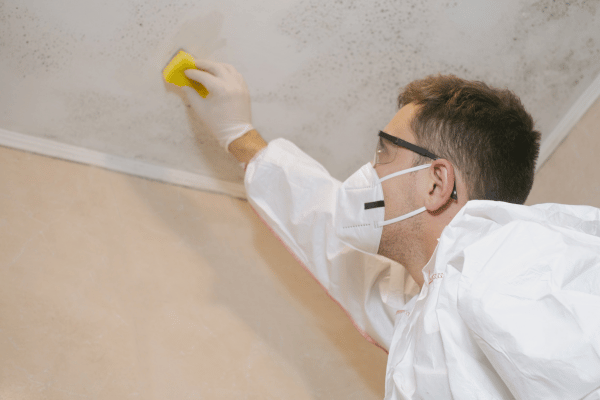
A man wearing a mask cleaning mold from a surface.

Areas We Serve

Black circular icon with the number 1 in white, minimal flat design symbol commonly used for step four, countdowns, rankings, or list indicators.

Find the water

We locate the moisture source and take readings behind the surface, because the growth you can see is rarely where it started.

Black circular icon with the number 2 in white, minimal flat design symbol commonly used for step four, countdowns, rankings, or list indicators.

Contain and remove

The work area is sealed under negative air pressure so spores do not travel through the house, then porous material that cannot be cleaned comes out.

Black circular icon with the number 3 in white, minimal flat design symbol commonly used for step four, countdowns, rankings, or list indicators.

Verify and prevent

Air quality testing confirms the spore count dropped, and the moisture condition that caused it is corrected so it does not return.